
You are not your thoughts: an introduction to mindfulness
- Peter Mcloughlin

- Aug 12, 2023
- 10 min read
Updated: Aug 27, 2023
The mind
as a mirror
as the sky
as an open hand.

What is mindfulness
and how might it help me?
The challenge right from the off is in trying to describe something that's almost entirely experiential. That is to say, that we can write and read about mindfulness like we can write and read about jumping into cold water: we can lay out what it does to the mind, how the body reacts the moment it plunges into that icy body of water, but none of it will gift you an understanding that is comparable to the raw felt experience of taking that leap yourself. Of the sheer joy in the shock as you come up for air. Likewise, we can spend a lot of time logically explaining what mindfulness is, the science behind it and what it may do for you and to you, but will that help you be any more mindful? Will reading about mindfulness gift you the ability to relax into the present moment with the swiftness of a matchhead igniting into a flame? Will words on a page help ground and sooth your anxious body?
Tell you what - it's experiential, so let's try an experiment. What do you think? You're reading this right now, so let's try it!
First, notice how you're reading this. Did you experience some anxiety the moment you read the suggestion of an experiment? Are you in a relaxed state, fully taking in each word? Or are you scanning the sentences with something like a quiet but frantic urge to get to the point? Are you open in your mind, in a way that will allow you to learn something new here - or are you coldly scouring for the first sign of bullshit, so you can use it as an excuse to snort and dismiss the entire concept of mindfulness? Are you calm, and present? Or are you already wrestling with the urge to close this page and move on to something new?
Notice now what's happening in your body - did you just smile to yourself - or did you feel something like a hot flush of shame, or guilt?
Is your heart beating slow, or fast?
What's your posture like?
Pause. Just a moment.
Take a breath - slow, and deep.
Take one more.
How does your body feel?
Can you relax the muscles around your eyes?
Can you relax any tension in your jaw?
Now, we're going to notice how the mind colours our experience. Just lift your head and look around the space you're in, taking in the objects and features of your environment. Then come back to these words. Just for a few moments, noticing whatever it is you notice. Go for it--
So, let's think reflect a little on the experience you just had: did your mind name and label the things it saw? Did you judge what you saw as either good, or bad? Did you feel a sense of lack, or frustration, because of how your environment made you feel about yourself? - or did you feel quietly smug because the space you're in seems particularly well-kept and fancy?
Take another deep breath, if you like.
Now, we're going to lift our gaze again. But this time, we're going to do it without analysing anything. Without labelling, without judgement. Just relax, and let your eyes take in what they take in, without making any effort. Go for it--
Take one more deep breath.
Did you notice any difference in the quality of your mind when you actively avoided labelling or judging what you saw?
What we're hopefully touching upon here is the difference between 'seeing', and thinking about what you see.
Regardless: congratulations, you've just completed a mindfulness drill! You paid attention, in a particular way, to what was actually going on both internally and externally around you, and you experimented with the difference between doing so critically, and doing so while reserving judgement.
Hopefully, what you noticed during this experience is that, firstly, we may be carrying agitation or tension in the body and in mind and not even be aware of it. But with our breath and our conscious attention, we can calm this agitation and tension quite quickly.
And secondly that there is a difference between the chatter in our mind, and the actual reality of our experience. Between the story you are telling yourself and the way things really are. And the more we quiet the mind, the more we open the heart, the better able we are to tap into this awareness that exists behind our critical mind.
Or - you know - you may not have felt or noticed much at all. And that's fine too.
One of the core foundations of mindfulness practice is that we let go of judgements around it all as much as possible. So it isn't either good, or bad; you didn't do it well or do it poorly. It simply was what it was - and it was more than enough.
As they say - it's simple, but it isn't always easy.
If you'd like to learn more about the concept, history and theory of mindfulness, read on.
Introducing mindfulness

Mindfulness as a concept is at least two and a half thousand years old. The notion of ‘right mindfulness’ was considered a component part of the ‘Noble Eightfold Path’, the path in early Buddhist practices that was said, in simple terms, to lead to the end of 'dukkha', often translated as suffering, or clinging.
From its very origin then, we can say that mindfulness as a practice was used by individuals to help reduce the amount of unnecessary suffering in their lives.
The concept of Mindfulness as we know it today was developed in the 1970’s by Jon Kabat-Zinn. At the time, Kabat-Zinn was a student at Massachusetts Institute of Technology (MIT), and while there he attended a lecture on Buddhist philosophies given by a Zen Buddhist master. This lecture inspired Kabat-Zinn to delve into Mindfulness-based practices within the various forms of Buddhism, which in turn led to him eventually developing a secular, non-religious set of principles that would form the basis of the now famous ‘Mindfulness-Based Stress Reduction’ programme.
This MBSR programme, removed somewhat from the context of its Eastern origins, has since spread across the Western world.
It has been said in the past that Buddhism is 'Hinduism stripped for export'. We might say, somewhat tongue-in-cheek, that Mindfulness as we know it now is likewise 'Buddhism stripped for export' -- or certainly, that Mindfulness today is based on a number of the key concepts and practices from various forms of Buddhism, but doesn't necessarily align itself with Buddhist, or any other, religious ideology.
In other words, Mindfulness as we teach and practice it today is not a religious discipline. Nor need it be inherently 'spiritual'. In many respects it is simply a practical, scientifically-back practice that helps focus our attention and reduce unnecessary suffering in our lives. And who wouldn't want to do that?
So, what actually is it?
"Mindfulness is the awareness that comes from paying attention in a particular way, on purpose, in the present moment, and non-judgmentally."
- Professor Jon Kabat-Zinn
(Founder of MBSR programme)
“I define mindfulness as the practice of being fully present and alive, body and mind united. Mindfulness is the energy that helps us to know what is going on in the present moment.”
- Thich Nhat Hanh
(Spiritual Leader)
Neuroscientists describe the similarly: as an observing of what is apparent to your consciousness in the present moment. The smells, feelings, sights, and sounds – rather than simply judging or thinking about it, it is the process of noticing or observing it simply as it is; forms of energy and matter, of light and shadow.
No matter how we define it, the quality of mindfulness remains the same. It is a practice we engage in both formally and informally, of striking the match; from being consumed by our thoughts, to settling with a relaxed openness into the raw physical sensation of what we are actually experiencing in the present moment.

Five Core Features of Mindfulness
Observing in a sensual way, rather than in an analytical way, the state of the present moment
Noticing the particular features of the moment you are in: what you see, hear, feel, sense, smell, taste etc.
Full participation in the present moment – that sense of committed intention, rather than half-hearted being - often the one thing holding us back truly is our reluctance to fully commit to where we are and what we have in front of us
Being non-judgemental. Focusing on what is happening without passing judgement. Without attaching labels and emotional overtones like good or bad, right or wrong, enjoyable or insufferable. Not trying to control your experience but allowing it to unfold in front of you with gentle curiosity
Concentrating on one thing at a time.
Simple, but not easy!
The nine pillars of mindfulness
Jon-Kabat Zinn developed the '7 pillars of mindfulness' in building his MBSR course, and then later added two more pillars to the list.
1. Beginners Mind
2. Non-judging
3. Acceptance
4. Letting Go
5. Trust
6. Patience
7. Non-striving
8. Gratitude
9. Generosity
We explore these pillars in great detail in our courses, and will deep dive into each one in separate blog posts, but for now, you can watch the video below for an introduction to each concept.
Types of Practice: Formal and Informal
State and trait.
With mindfulness there is formal practice and there is informal practice. Formal practice is the state: the sitting down and intentionally meditating, directing your attention to your breath, for example. It is completing the drill like we did in the beginning of this post.
Informal practice is what you do with the rest of your life.
As Lorraine Weiss says in “Tabula Rasa” – where your life becomes your meditation.
Where you begin to be able to step back, at a moment’s notice, from the identification with thought – from being emotionally swept up in whatever your mind is consumed by in that moment - to resting in the more open and peaceful seat of awareness we all possess.
Generally speaking, we start by practicing formally to develop the skill, and eventually, we find we can tap into it informally, wherever we are.
The opposite of Mindfulness: 'Mindlessness', or Automatic Pilot
Another way to conceptualise mindfulness may be to consider it’s opposite: mindlessness, or doing things habitually and without conscious attention. The term 'automatic pilot' describes the way in which our brain stores certain behaviour patterns as habits to save time. Over-simplifying somewhat, but it’s basically an evolutionary way in which we save energy, as we store actions and certain thought patterns in our brains to avoid having to freshly process the same information over and over again. This has many obvious benefits, of course: a good example being driving. If we had to consciously pay attention to everything we were doing each time we climbed into the driver's seat, we'd be exhausted after every drive. So much of the process of driving is handled by the automatic pilot.
However, living with this automatic pilot in control at all times can have its drawbacks.
The expression, 'the mind is a wonderful servant, but a terrible master' sums it up well. Great if we know how to use it and control it; potentially terrible if left to run away with itself.
For example, if we have instilled certain negative behaviour or thought patterns in our lives, particularly from a young age, these patterns may end up being actively or passively destructive. They may encourage us to think or behave in ways that harm us or that cause needless conflict in our relationships with others. It might support addiction or ignorance or an attitude of self-loathing – any number of unintentional, harmful things.
Mindfulness is a way of stepping back a bit from the autopilot and considering more effectively where our behaviour patterns and our minds are trying to take us – and whether we really want to go there at all.
The upside to the notion of the auto-pilot and the notion of stored behaviour and thought patterns is worth pointing out too though. Our minds are not fixed; we can re-wire how we behave, how we think, with time and effort. And these more potentially positive or helpful behaviour and thought patterns, if practiced often enough, will also become more habitual and regular, and so become automatic themselves. So we don't have to fight our entire lives to think or feel more positively, for example. Those first months of changing habits and beliefs are the hard part. But the fight begins to win itself, after a time: our more helpful and healthful behaviour and thought patterns begin to become our more automatic responses, and we begin to leave the old 'us' behind.
So why would we do it?
The Science of Mindfulness
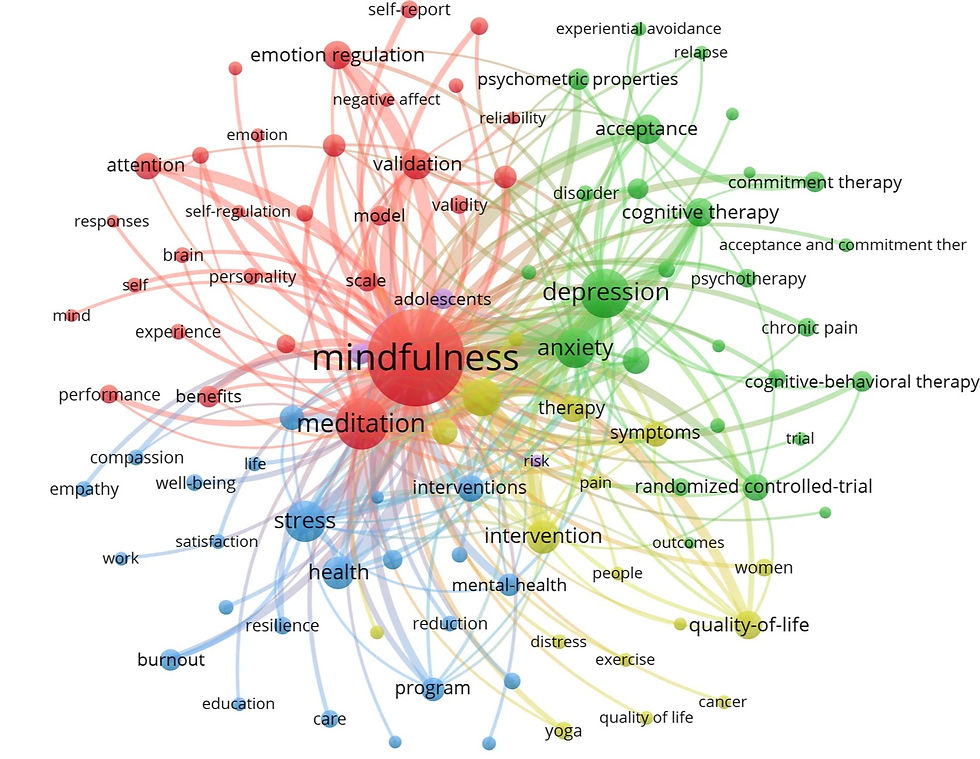
In short, the vast majority of all we suffer is more to do with the story we are telling ourselves about our experience, than it is to do with the actual experience itself.
Mindfulness helps guide us away from identifying too closely with the story, and helps brings us back to the moment we're actually in, so that we can avoid a great deal of unnecessary psychological suffering.

If we are experiencing anxious thoughts, stressful or intrusive or painful thoughts about the self or about others, mindfulness can help us grow space between these thoughts and our emotional connection to them.
If we behave routinely in ways that harm us, that are detrimental to others or to our relationship with others, mindfulness can help us build more conscious and beneficial behaviour patterns, so we will be able to engage more positively with the world.
We can use mindfulness and positive psychology to rebuild our sense of self, and have a kinder and more compassionate relationship with ourselves and with others.
The value of your attention
“All of humanity's problems stem from man's inability to sit quietly in a room alone.”
- Blaise Pascal, Pensées
Simply put, your attention is the most valuable tool you have. Think about it: everything you will ever learn, everyone you ever successfully interact with; every skill you develop and every pleasure you experience in life is a result of your focused attention.
And yet we give it away so cheaply, don't we? To social media, to the internet, to TV and games. To other people; to our mind's anxious wanderings. In fact, a lot of the time, we're desperate to give our attention away. We're practically begging to be distracted as much as we possibly can. Why do you think that is?
The ability to sit comfortably where you are, in the moment you're in, without looking at your phone, without needing a screen to look at or a person to talk to, without anxiously leaning in to the next moment; the ability to simply sit and be - with your thoughts and your body as they are - without needing to distract yourself, is a legitimate superpower in the modern world.
And so it follows; the ability to consciously direct your attention towards the things you care about, towards positive thoughts, positive actions, towards study and growth and towards experiences and people that will enrich your life in the long-run, is not a given. It takes effort, and practice.
Mindfulness is that practice.
So what do you think?
Would you like to suffer less?
Would you like to feel more comfortable, and present, and relaxed, no matter where you are or what you are doing?
Would you like to be able to direct your attention in such a way that you are able to act in a more caring, compassionate, and positive way in the world?
It's a rhetorical question, of course. Because why wouldn't you?

Comments